
Overview
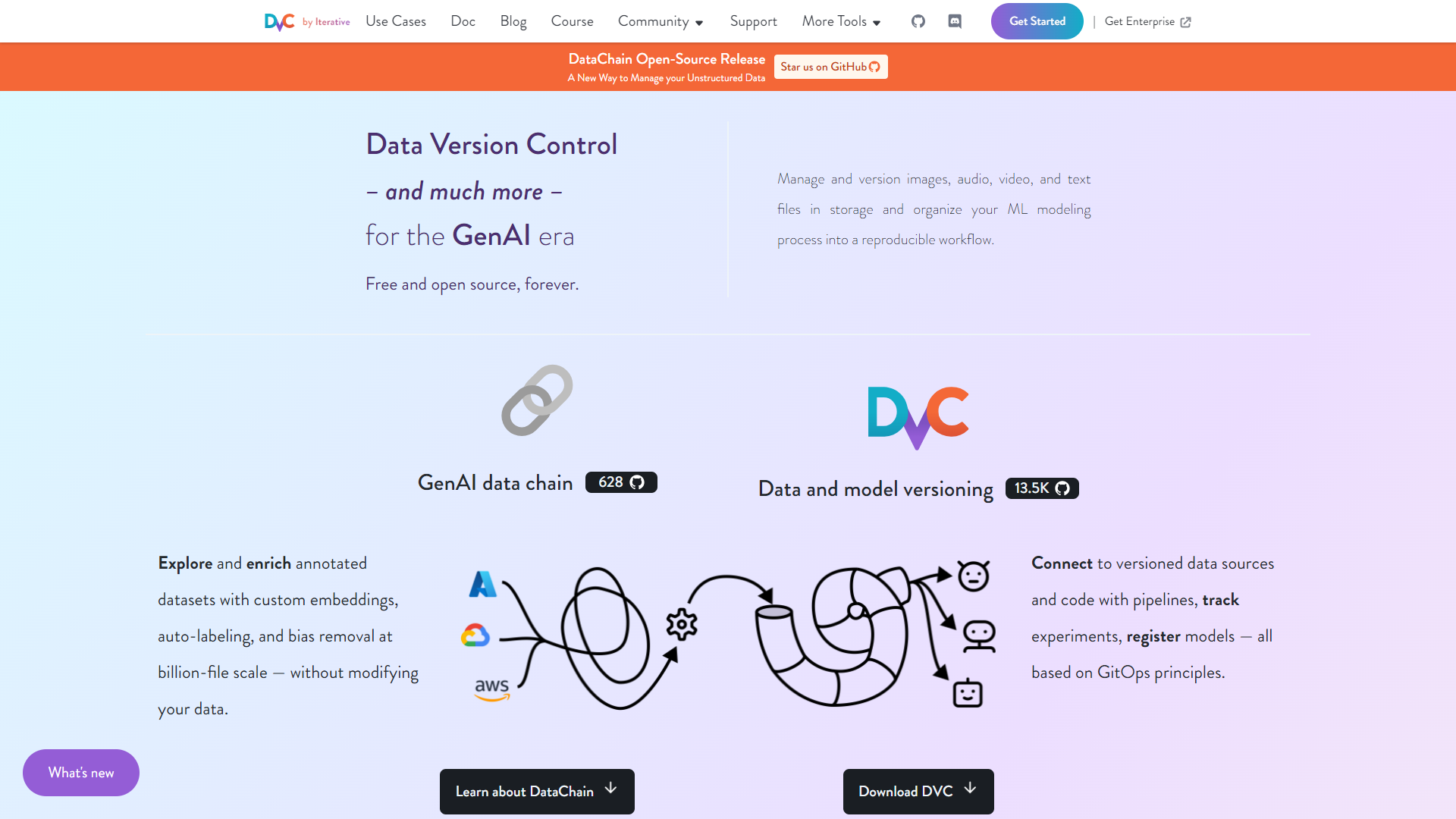
DVC, or Data Version Control, is an open-source tool designed to streamline the management of machine learning datasets. It allows users to version control their data, code, and models, ensuring that every change is tracked and reproducible. With DVC, teams can collaborate more effectively, reducing confusion and enhancing productivity in data science projects.
Key features
Data Versioning
DVC allows users to keep track of changes in datasets, making it easy to revert to previous versions if needed.
Integration with Git
DVC works seamlessly with Git, adding data versioning capabilities to your existing workflows.
Pipeline Management
Users can define data processing pipelines, tracking all stages from raw data to model training.
Cloud Storage Support
DVC supports various cloud storage options for data storage, improving accessibility and collaboration.
Reproducibility
By keeping a detailed record of experiments, users can ensure that results can be reproduced accurately.
Collaboration Tools
DVC makes it easy for teams to share data and models, fostering a collaborative environment.
Performance Optimization
DVC is designed to work efficiently with large datasets without slowing down project workflows.
Open-Source and Free
Being open-source, DVC is free to use, making it an accessible option for everyone.
Pros
- Enhances Team CollaborationDVC fosters better communication and collaboration among team members in data projects.
- Simplifies Experiment TrackingUsers can easily track and manage their experiments and results.
- No Additional CostAs an open-source tool, DVC can be used without any licensing fees.
- FlexibleDVC supports multiple storage options, making it flexible to different project needs.
- Improves Project OrganizationDVC helps keep data, code, and configurations organized, reducing chaos in large projects.
Cons
- Steep Learning CurveNew users may find it somewhat challenging to learn and implement DVC effectively.
- Requires GitUsers need to have a good understanding of Git to take full advantage of DVC.
- Limited GUIDVC primarily relies on command-line interfaces, which may be daunting for non-technical users.
- Performance IssuesWhile designed for efficiency, handling very large datasets may still cause slowdowns.
- Compatibility ConcernsUsers may face integration issues with certain data storage solutions.
FAQ
Here are some frequently asked questions about DVC.
DVC stands for Data Version Control, a tool for managing datasets in machine learning projects.
DVC integrates with Git to add data management capabilities to your existing version control workflows.
Yes, DVC is an open-source tool and is completely free to use.
Yes, DVC is designed to work efficiently with large datasets, but performance may vary based on the setup.
DVC supports various cloud storage providers, including AWS S3, Google Drive, and Azure.
While it's helpful to understand Git, DVC does include documentation for users who are new to version control.
DVC is primarily designed for machine learning, but it can be adapted for any project that requires data versioning.
DVC offers detailed documentation and community support for troubleshooting and guidance.


