
Synaptic js
A powerful library for building neural networks in JavaScript.
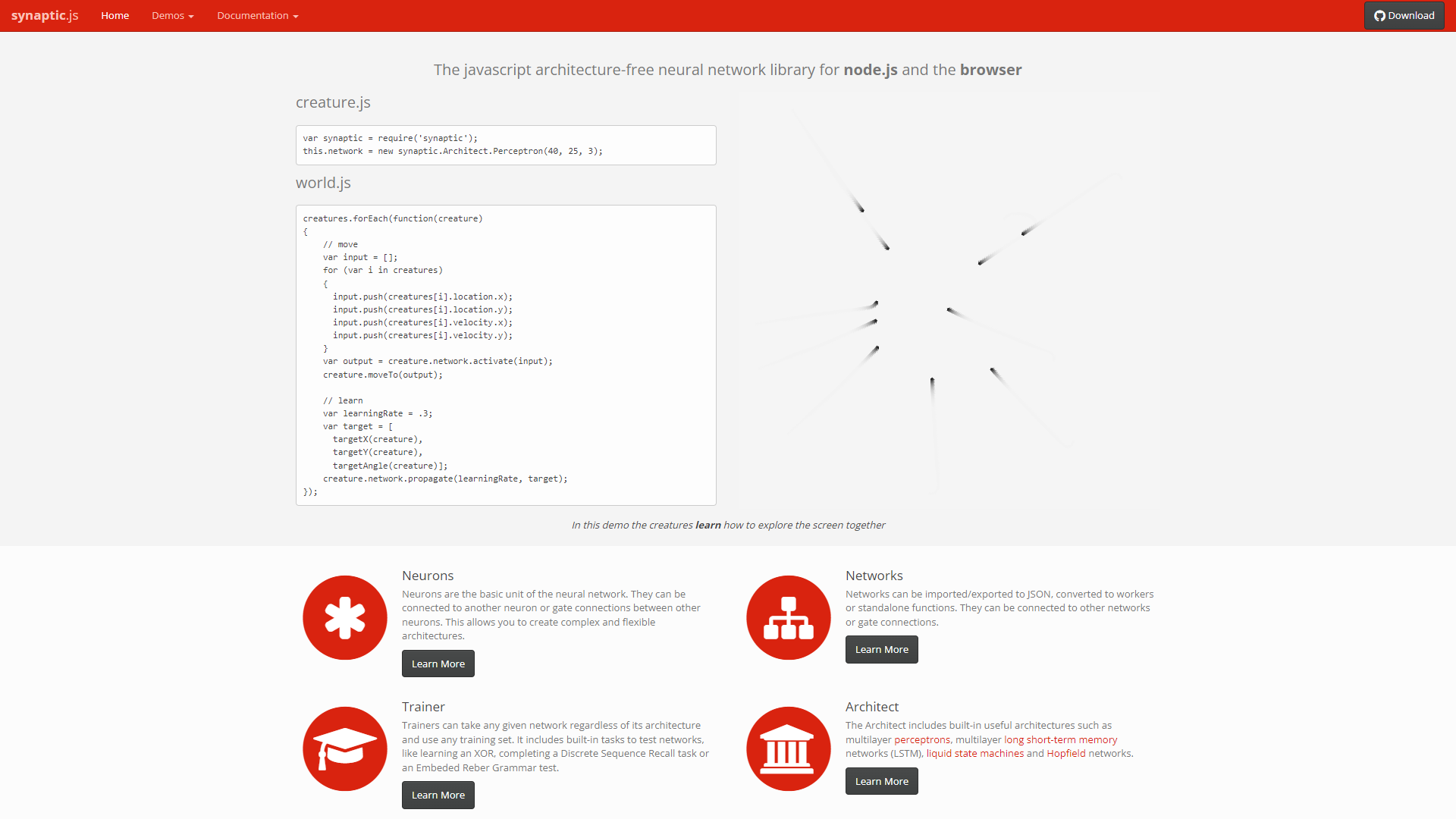
Overview
Synaptic.js is a JavaScript library designed to help developers create and train neural networks easily. It provides a simple syntax and flexible architecture that makes implementing complex models more accessible. The library is suitable for both beginners and experienced developers who want to integrate machine learning into their web applications.
One of the key benefits of Synaptic.js is its flexibility. You can build any type of neural network structure you want, from simple feedforward networks to complex recurrent networks. This allows developers to experiment with different architectures to find the best fit for their specific use cases.
Additionally, Synaptic.js is lightweight and does not rely on heavy dependencies. This makes it a great choice for web developers who want to add machine learning functionalities without compromising their application's performance. Its user-friendly features and extensive documentation help developers get started right away.
Key features
Flexible Architecture
Synaptic.js allows you to construct various types of neural networks, customizing them to suit your needs.
Simple Syntax
Its easy-to-understand syntax makes it accessible for users with different levels of programming experience.
Lightweight Library
The library is designed to be small and efficient, ensuring faster load times for web applications.
Built-in Layers
Synaptic.js includes pre-defined layers, such as perceptrons and LSTMs, for quicker model building.
Training Capabilities
You can train your neural networks using backpropagation and other advanced training algorithms.
Interactive Visualization
The library supports tools for visualizing neural networks, making it easier to understand their structure.
Compatibility
Synaptic.js can run in both browsers and Node.js, providing flexibility for various development environments.
Community Support
With a growing community of developers, you can find tutorials, examples, and help easily.
Pros & Cons
Pros
- Easy to Learn
- Highly Customizable
- Light and Fast
- Active Community
- Rich Documentation
Cons
- Limited Advanced Features
- Not Ideal for Large Datasets
- Basic Performance
- Learning Curve for Complex Structures
- Less Popular
Rating Distribution
User Reviews
View all reviews on G2Review for Synaptic.js
What do you like best about Synaptic.js?
Synaptic.js is the best library we have used in our development processes to support the contain orchestration in Kubernetes. It is also very cost-effective, has multiple features like the easy connection with various networks, supports multilayered architecture, and can be used in any training set.
What do you dislike about Synaptic.js?
The library is open-source. If any urgent issue arises, we have to hold our development work until a fix comes up. Last time due to one code issue, our deployment process hung in between. Upon investigation, we found that some [particular lines were not supporting one of the layers in our architecture. That caused a spike in our development work.
What problems is Synaptic.js solving and how is that benefiting you?
We are using many Synaptic.js libraries in our development, which has benefitted us greatly. The library supports many of our multilayered architecture and contributes to many features of our app. One of the major ones is alerting and deployment process. The unit tests are more straightforward than other libraries like GCDL Containers and AWS.
The best option for neural network
What do you like best about Synaptic.js?
Some time ago we were doing some neural network tests and Synaptic.js was our first option to take into account, at first it seemed like a better idea to use python, but here we say that it is not worth reinventing the wheel, Synaptic.js offers us just what w...
Best neural network library for Node.js
What do you like best about Synaptic.js?
It is very easy to build a neural network in Javascript by making use of Synaptic.js. It includes built-in architectures like multilayer perceptron, Hopfield networks, etc. Also, there aren't many other libraries out there that allow you to build a second ord...
Easy to use javascript neural network library
What do you like best about Synaptic.js?
It is straightforward to start coding the neural network in javascript using the synaptic library. I had previously coded the neural network by myself, so the abstraction provided by the library, like synaptic, is constructive.
What do you dislike about Syna...
Best Architecture - free neural network library for node.js
What do you like best about Synaptic.js?
The best thing about synaptic.js is it has many predefined network types like multilayer perceptrons, long-short-term memory networks, etc. It is one of the very few which allows you to create second order and recurrent networks.
What do you dislike about S...
Company Information
Alternative Artificial Neural Network tools


FAQ
Here are some frequently asked questions about Synaptic js.
Synaptic.js is a JavaScript library for building and training neural networks.
Yes, Synaptic.js can be used in both browsers and Node.js.
Yes, it has a simple syntax that makes it easy for beginners to learn.
You can create simple feedforward networks as well as more complex recurrent networks.
Yes, Synaptic.js includes tools for visualizing the neural network's structure.
Yes, Synaptic.js has extensive documentation to help you get started.
Yes, you can train your models using various algorithms provided by the library.
Some limitations include less advanced features and challenges with very large datasets.


