
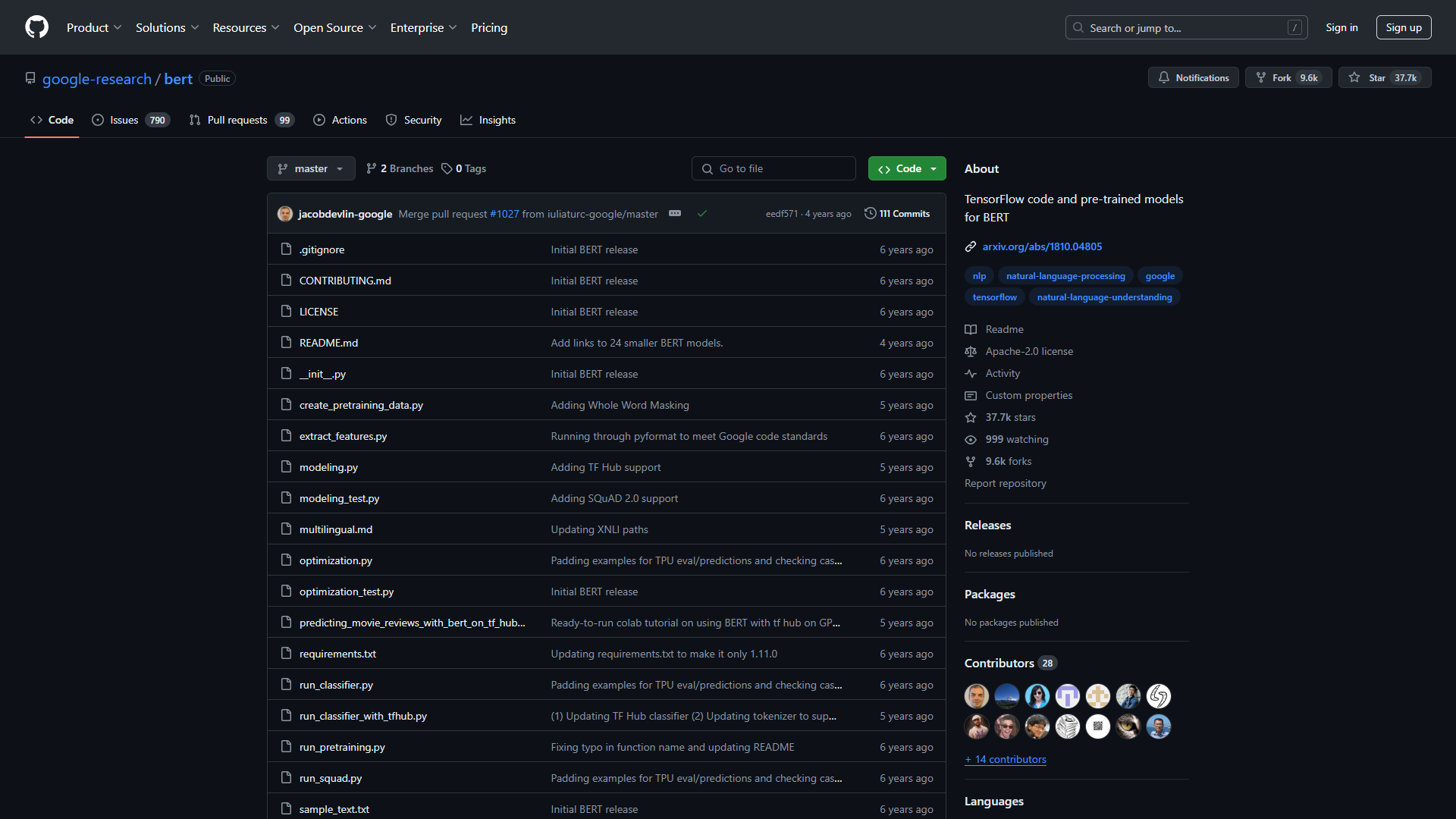
Overview
BERT, which stands for Bidirectional Encoder Representations from Transformers, is a groundbreaking model in the field of natural language processing (NLP). It was developed by Google and has gained much attention for its ability to understand context in language. Unlike earlier models, BERT reads text in both directions, which allows it to gather a complete understanding of words based on their surroundings.
The model uses something called transformers, which are layers of algorithms that analyze data. By using these transformers, BERT learns from huge amounts of text data and improves its ability to predict words when given a sentence. This means it can handle complex language tasks such as question answering and sentiment analysis with higher accuracy than before.
BERT is not just for Google; it’s made accessible to many developers and businesses aiming to enhance their applications. With BERT, tasks like searching for information, chatbots, and translating languages can become much smarter, making interactions with technology feel more natural and human-like.
Key features
Bidirectional Understanding
BERT processes text in both directions, improving its grasp of context.
Transformer Architecture
It uses transformers to analyze language patterns effectively.
Pre-training and Fine-tuning
BERT can be pre-trained on large datasets and fine-tuned for specific tasks.
Support for Multiple Languages
BERT can understand and process various languages, making it versatile.
Open Source Availability
Google has made BERT's code open source, allowing developers to use it freely.
Effective for Various Tasks
It excels in tasks like question answering, language inference, and sentiment analysis.
Large-scale Training
BERT is trained on large datasets, which enhances its learning and adaptability.
Enhanced Search Capabilities
Used in search engines, it helps deliver more relevant results based on user intent.
Pros
- High AccuracyBERT offers outstanding performance in understanding language, leading to precise results.
- Natural Language UnderstandingIt enables more natural interactions between users and machines.
- Flexible ApplicationWorks well across many different language tasks and industries.
- Community SupportBeing open source means there are many resources, tutorials, and community help available.
- Continuous ImprovementsBERT is updated and improved regularly, keeping it current with technology trends.
Cons
- Resource IntensiveBERT requires significant computing power, which may be a barrier for some users.
- Complex ImplementationSetting it up properly can be complicated for beginners.
- Less Effective for Short TextsIt performs best with longer sentences, sometimes missing context in shorter texts.
- Training TimeFine-tuning the model can take a long time, which might not be practical for everyone.
- Dependence on Quality DataThe accuracy of BERT depends heavily on the quality and quantity of training data.
FAQ
Here are some frequently asked questions about BERT.
BERT stands for Bidirectional Encoder Representations from Transformers.
BERT was developed by Google.
BERT reads text in both directions, allowing it to understand context better.
Yes, BERT supports multiple languages, making it very versatile.
Yes, BERT's code is open source, so anyone can use it.
BERT can handle tasks like question answering, sentiment analysis, and language translation.
Transformers are advanced algorithms that allow BERT to analyze language patterns accurately.
The main challenges include the need for powerful hardware and the complexity of implementation.


