
SuperAnnotate
SuperAnnotate simplifies image labeling for AI projects.
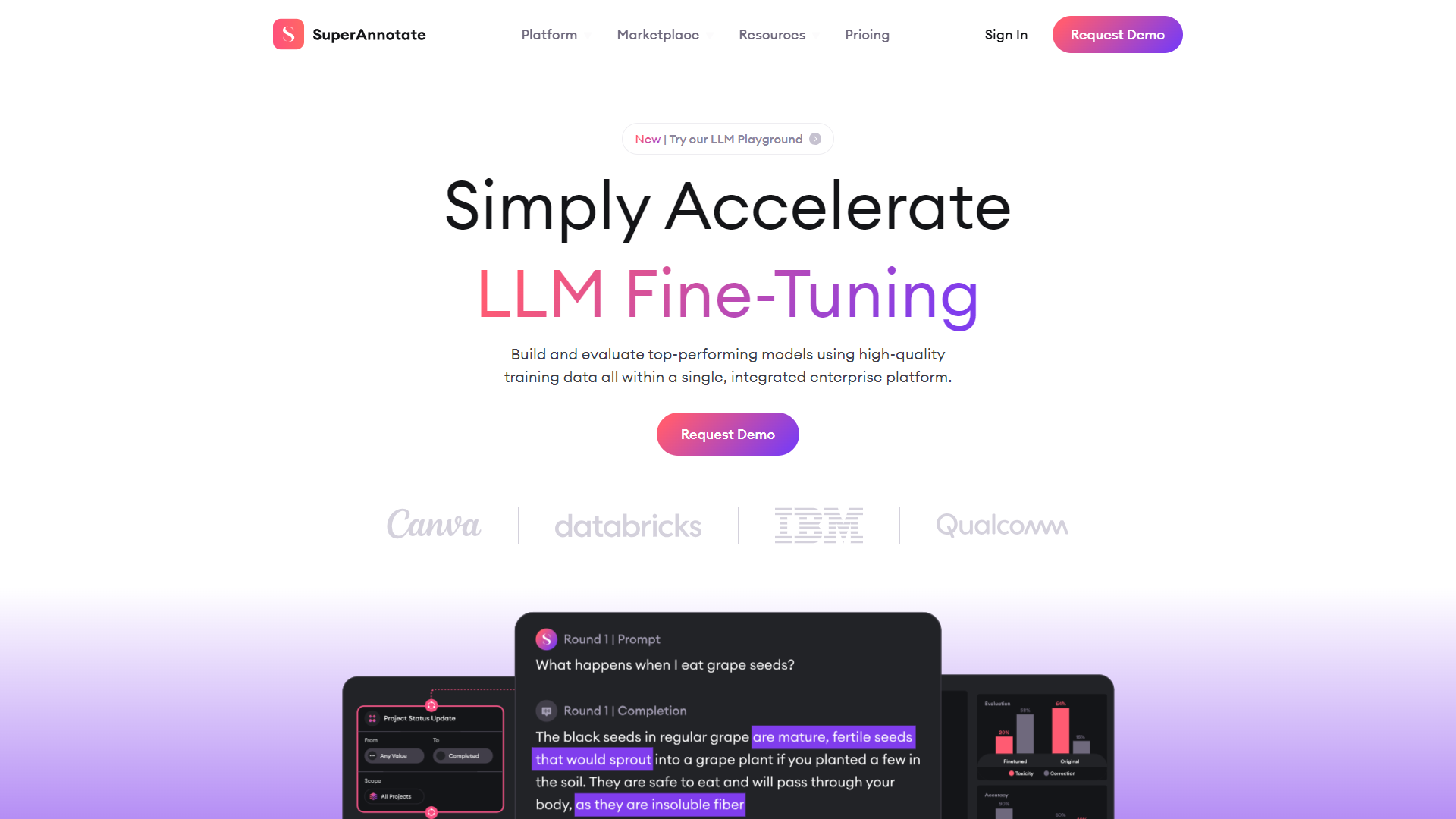
Overview
SuperAnnotate is a powerful tool designed to help users label images quickly and efficiently for artificial intelligence projects. With an easy-to-use interface, it allows teams to create high-quality annotations that are essential for machine learning models. The platform caters to a wide range of industries, making it a versatile choice for many organizations.
One of the standout features of SuperAnnotate is its collaborative nature. Multiple users can work on projects simultaneously, making it perfect for teams that need to meet tight deadlines. Alongside this, the tool offers robust support for various types of annotations, including bounding boxes, polygon segmentation, and keypoint detection, enhancing its utility for different AI tasks.
In addition to its annotation capabilities, SuperAnnotate integrates seamlessly with AI workflows and supports file formats commonly used in the industry. This means that once the images are labeled, they can be easily exported for further processing. Overall, SuperAnnotate makes the annotation process smoother, quicker, and more effective.
Pricing
| Plan | Price | Description |
|---|---|---|
| Free Startup Plan | Free | Start using SuperAnnotate for free if you qualify for our early-stage startup program. |
| Pro | Contact Us | Your go-to package for building annotated datasets at scale to meet your most sophisticated project needs. |
| Enterprise | Contact Us | Customizable package best suited for well-established, recurring high-volume projects with a clear-cut strategy. |
Key features
Easy-to-use interface
The platform is designed for users of all skill levels, making it simple to get started with image annotation.
Collaborative annotation
Multiple team members can work on projects at the same time, improving productivity.
Support for various annotation types
Users can create bounding boxes, polygons, and keypoints, catering to a variety of AI needs.
Integration with AI workflows
SuperAnnotate easily connects with other tools in the AI development process.
Version control
Maintain a history of changes made to projects, allowing for easy tracking and management.
Customizable workspace
Users can tailor the UI to fit their preferences, making the experience more enjoyable.
Robust exporting options
Export annotations in various formats suitable for different machine learning frameworks.
Extensive tutorials and support
Comprehensive resources are available to help users get the most out of the platform.
Pros & Cons
Pros
- User-friendly design
- High-quality annotations
- Boosts teamwork
- Scalable solution
- Regular updates
Cons
- Cost
- Learning curve for advanced features
- Internet dependency
- Limited offline capabilities
- Occasional bugs
Feature Ratings
Based on real user reviews, here's how users rate different features of this product.
Deployment
Allows users to input models built in a variety of languages.
Allows users to choose the framework or workbench of their preference.
Records versioning as models are iterated upon.
Provides a way to quickly and efficiently deploy machine learning models.
Offers a way to scale the use of machine learning models across an enterprise.
Allows users to input models built in a variety of languages.
Allows users to choose the framework or workbench of their preference.
Records versioning as models are iterated upon.
Provides a way to quickly and efficiently deploy machine learning models.
Offers a way to scale the use of machine learning models across an enterprise.
Management
Records and organizes all machine learning models that have been deployed across the business.
Tracks the performance and accuracy of machine learning models.
Provisions users based on authorization to both deploy and iterate upon machine learning models.
Allows users to manage model artifacts and tracks which models are deployed in production.
Records and organizes all machine learning models that have been deployed across the business.
Tracks the performance and accuracy of machine learning models.
Provisions users based on authorization to both deploy and iterate upon machine learning models.
Quality
Gives user a metric to determine the quality of data labelers, based on consistency scores, domain knowledge, dynamic ground truth, and more. This feature was mentioned in 54 SuperAnnotate reviews.
Based on 54 reviewsEnsures that labeling tasks are accurate through consensus, review, anomaly detection, and more. This feature was mentioned in 52 SuperAnnotate reviews.
Based on 52 reviewsEnsures the data is of a high quality as compared to benchmark. This feature was mentioned in 55 SuperAnnotate reviews.
Based on 55 reviewsGives user the ability to review and edit labels. This feature was mentioned in 47 SuperAnnotate reviews.
Based on 47 reviewsAutomation
Based on 37 SuperAnnotate reviews. Uses models to predict the correct label for a given input (image, video, audio, text, etc.).
Based on 37 reviewsAutomatically route input to the optimal labeler or labeling service based on predicted speed and cost. 27 reviewers of SuperAnnotate have provided feedback on this feature.
Based on 27 reviewsImage Annotation
Has the ability to place imaginary boxes or polygons around objects or pixels in an image. This feature was mentioned in 50 SuperAnnotate reviews.
Based on 50 reviewshas the ability to detect objects within images. 48 reviewers of SuperAnnotate have provided feedback on this feature.
Based on 48 reviewsTrack unique object IDs across multiple video frames This feature was mentioned in 39 SuperAnnotate reviews.
Based on 39 reviewsSupports a range of different types of images (satelite, thermal cameras, etc.) 41 reviewers of SuperAnnotate have provided feedback on this feature.
Based on 41 reviewsNatural Language Annotation
As reported in 26 SuperAnnotate reviews. Gives user the ability to extract entities from text (such as locations and names).
Based on 26 reviewsGives user the ability to tag text based on its sentiment. 19 reviewers of SuperAnnotate have provided feedback on this feature.
Based on 19 reviewsAs reported in 23 SuperAnnotate reviews. Gives user the ability to label and verify text data in an image.
Based on 23 reviewsSpeech Annotation
As reported in 20 SuperAnnotate reviews. Allows the user to transcribe audio.
Based on 20 reviewsBased on 19 SuperAnnotate reviews. Gives user the ability to label emotions in recorded audio.
Based on 19 reviewsOperations
Control model usage and performance in production
Deploy mission-critical ML applications where and when you need them
Easily compare experiments—code, hyperparameters, metrics, predictions, dependencies, system metrics, and more—to understand differences in model performance.
Prompt Engineering - Large Language Model Operationalization (LLMOps)
Provides users with the ability to test and optimize prompts to improve LLM output quality and efficiency.
Gives users a collection of reusable prompt templates for various LLM tasks to accelerate development and standardize output.
Model Garden - Large Language Model Operationalization (LLMOps)
Offers tools for users to compare multiple LLMs side-by-side based on performance, speed, and accuracy metrics.
Custom Training - Large Language Model Operationalization (LLMOps)
Provides users with a user-friendly interface for fine-tuning LLMs on their specific datasets, allowing better alignment with business needs.
Application Development - Large Language Model Operationalization (LLMOps)
Gives users tools to integrate LLM functionality into their existing applications through SDKs and APIs, simplifying development.
Model Deployment - Large Language Model Operationalization (LLMOps)
Offers users the capability to deploy models quickly to production environments with minimal effort and configuration.
Provides users with tools to automatically scale LLM resources based on demand, ensuring efficient usage and cost-effectiveness.
Guardrails - Large Language Model Operationalization (LLMOps)
Gives users the ability to set boundaries and filters to prevent inappropriate or sensitive outputs from the LLM.
Offers users tools to ensure their LLMs adhere to compliance standards such as GDPR, HIPAA, and other regulations, reducing risk and liability.
Model Monitoring - Large Language Model Operationalization (LLMOps)
Gives users notifications when the LLM performance deviates significantly from expected norms, indicating potential model drift or data issues.
Provides users with live insights into model accuracy, latency, and user interaction, helping them identify and address issues promptly.
Security - Large Language Model Operationalization (LLMOps)
Provides users with encryption capabilities for data in transit and at rest, ensuring secure communication and storage when working with LLMs.
Offers users tools to set access permissions for different roles, ensuring only authorized personnel can interact with or modify LLM resources.
Gateways & Routers - Large Language Model Operationalization (LLMOps)
Provides users with middleware to route requests efficiently to the appropriate LLM based on criteria like cost, performance, or specific use cases.
Inference Optimization - Large Language Model Operationalization (LLMOps)
Gives users tools to process multiple inputs in parallel, improving inference speed and cost-effectiveness for high-demand scenarios.
Rating Distribution
Screenshots
User Reviews
View all reviews on G2Outstanding Affordance for Annotation Excellence
What do you like best about SuperAnnotate?
its exceptional affordance for intuitive and efficient workflow design
Comprehensive Support
Rich documents
I love this.
What do you dislike about SuperAnnotate?
This might be a matter of personal preference, but using a two-finger slide instead of a pinch gesture for zooming in and out feels a bit unnatural to me.
What problems is SuperAnnotate solving and how is that benefiting you?
SuperAnnotate simplifies the setup for annotating multimodal data.
Easy-to-use labeling software
What do you like best about SuperAnnotate?
I have used SuperAnnotate for half a year now (after testing a couple of other platforms) for annotation of images.
Compared to the other platforms I have tried, SuperAnnotate has an intuitive interface. It was straightforward to get familiar with the diff...
A very extensive set of image annotation tools
What do you like best about SuperAnnotate?
I was looking for a tool to annotate biological images. After trying many tools, I found two of the best platforms for myself. One of them is Superannotate. These platforms had the widest set of annotation tools, including exactly the ones I needed. The too...
SuperAnnotate - The Annotation Tool To Ease Data and Workforce Management
What do you like best about SuperAnnotate?
We are a data labeling workforce provider and have a team of 100+ annotators across projects. We started working on SuperAnnotate about a year ago, and since then have been increasing the number of projects we do on the platform, due to its ease of use, rel...
A Powerful Solution for Large-Scale Annotation Projects
What do you like best about SuperAnnotate?
SuperAnnotate offers well-structured documentation, making it easy to navigate and utilize the platform effectively. It's particularly suitable for larger-scale projects where annotation is a key task, thanks to its robust tools and features that streamline...
Company Information
Alternative Image Recognition tools


FAQ
Here are some frequently asked questions about SuperAnnotate.
SuperAnnotate is a tool designed for labeling images and creating high-quality datasets for AI and machine learning projects.
Yes, SuperAnnotate is designed with a user-friendly interface, making it accessible for both beginners and experienced users.
Absolutely! SuperAnnotate allows for collaborative annotation, so team members can work together in real-time.
You can create bounding boxes, polygons, and keypoints, which are all essential for various AI applications.
Yes, SuperAnnotate integrates well with many other tools and workflows used in AI development.
Yes, you can export your annotations in multiple formats suitable for various machine learning frameworks.
SuperAnnotate offers extensive tutorials and documentation to help you get started and make the most of its features.
Currently, SuperAnnotate primarily functions as a web application, with no dedicated mobile app available.
SuperAnnotate tracks changes made to projects, allowing users to see the history and restore previous versions if needed.


